Grey Wolf Grooming / Shaving guide
Safety Razor, Cartridge or Electric? Pick the Shave You Can Repeat
A decision guide to three razor systems, their trade-offs and what matters more than a close shave.
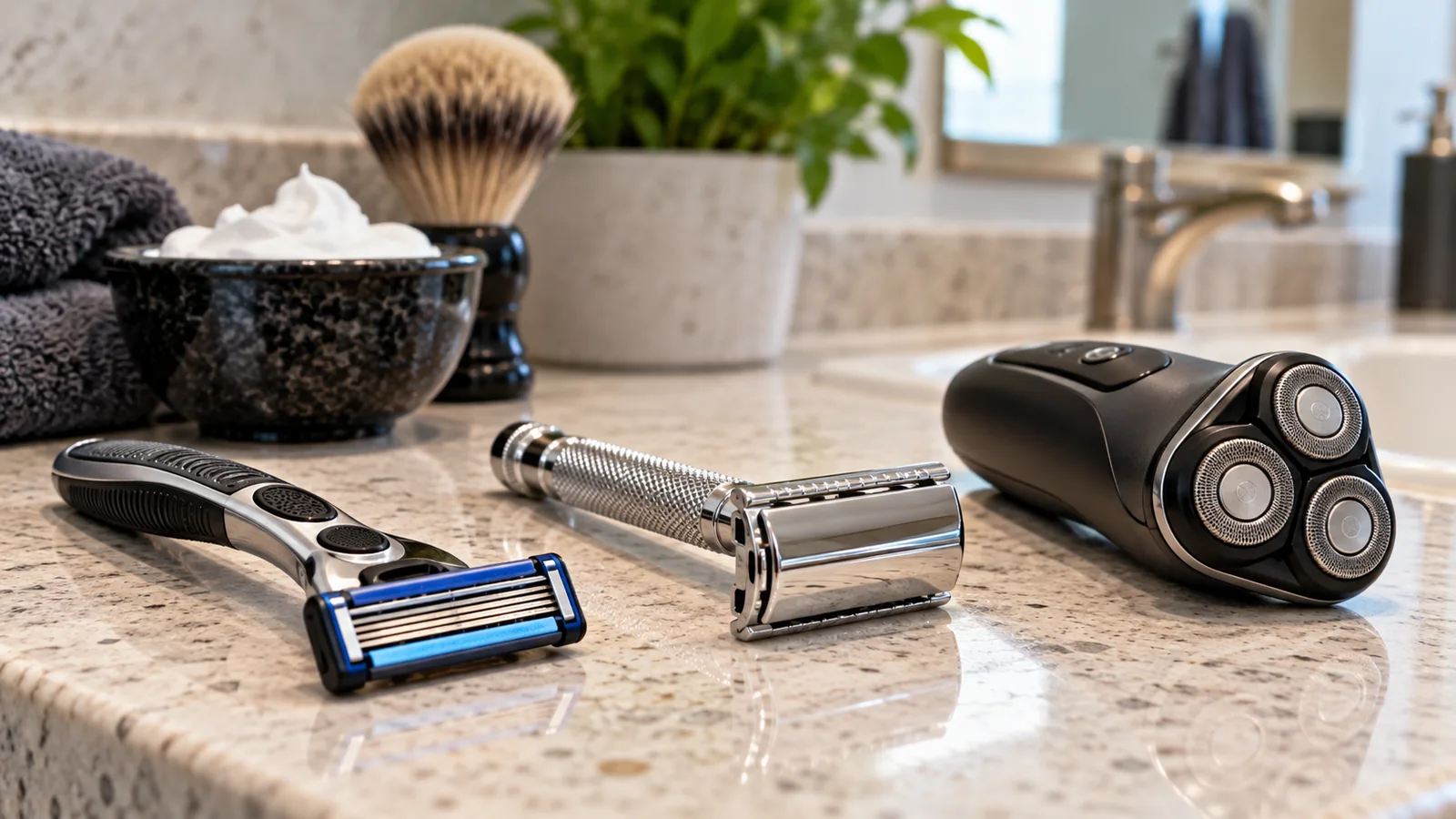
Compare the options
| Option | Strength | Trade-off | Best fit |
|---|---|---|---|
| Cartridge razor | Fast to learn; familiar handle | Refill costs and plastic waste | Routine wet shaves with little setup |
| Double-edge safety razor | Low-cost replacement blades; precise control | Angle and pressure take practice | Deliberate wet shaving |
| Foil electric | Quick routine, minimal lather as permitted | Head cleaning and replacements | Frequent short-stubble upkeep |
| Rotary electric | Moving heads for contours | Feel and closeness vary by person | Those who prefer rotary movement |
Start with the result you need
A close shave is not automatically a better shave. If you need to look tidy every morning, a comfortable, repeatable result beats chasing the closest possible pass. Think about your neck, how long your routine can take, your grip and dexterity, and whether you enjoy learning technique.
Cartridge razors: the convenient baseline
A cartridge system is easy to learn and readily available. Use short strokes and light pressure, rinse between passes, and replace a cartridge when it tugs or performance declines. Compare the cost of the exact refill family, not just the discounted starter handle.
Safety razors: economical blades, deliberate technique
A double-edge safety razor uses replaceable blades and demands attention to blade angle. Let the weight of the razor do the work rather than pushing. Practice on a straightforward cheek area before attempting a complicated neck pass. Blade exposure and handle geometry vary; do not assume all safety razors behave alike.
Electric: foil versus rotary
Foil shavers generally use oscillating cutters beneath a foil; rotary models use circular cutting heads. Neither is universally better. Check whether a particular model is rated for wet use, how to clean it, and the price of replacement heads. Never take a dry-only device into the shower.
Calculate the cost of ownership
A low initial price can conceal expensive cartridges or replacement heads. Compare a realistic year of refills, cleaning supplies and the time you will spend maintaining the tool. A premium shaver is not an automatic upgrade for someone satisfied with a basic razor.
Which system should you choose?
Choose a cartridge if convenience matters most. Try a safety razor if you are comfortable practicing and want inexpensive replaceable blades. Consider electric if speed and routine consistency matter more than traditional wet shaving. Stop at the first system that works comfortably.
For the next related decision, see foil and rotary electric shavers.
Frequently asked questions
Does a safety razor prevent irritation?
Not automatically. Technique, beard growth direction, pressure and blade condition matter.
Is electric shaving always less close?
Results vary by model and person; a comfortable finish is a better decision metric than a universal ranking.
Can I switch systems without buying everything again?
Yes. Begin with the device and its necessary consumables, not an entire collection of accessories.
Continue with the shaving guides
Start with the complete shaving guide. For an overview of grooming product ingredients, consult the ingredient guide. Links to companion guides may be activated during the coordinated bulk publication.